Danba Travel Guide
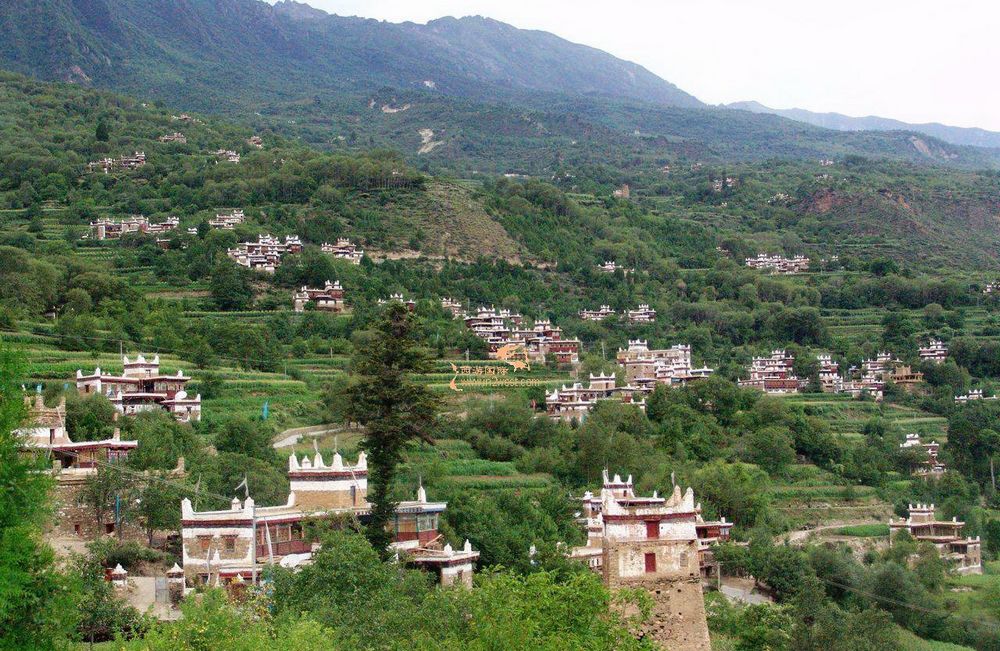
Danba, a county in the western part of Sichuan, in a deep valley, with the stone-built tall towers, the slope villages, and the Tibetan and the Qiang working life.
Danba Travel guide
This county lies in the western part of Sichuan Province, nestled along the upper reaches of the Dadu River. Bordered by high-altitude mountain ranges, its valley climate—cool in summer and chilly in winter—has long sustained the lives of those who carve fields into the slopes.
Along both banks of the valley stand tall towers built from stacked stones. These slender structures, with square or star-shaped bases, were traditionally erected near homes. The sight of sun-weathered stone walls lining the hillsides has become a quintessential image of this region.
On the terraced slopes, villages stretch out in tiers, their rows of houses with white walls and dark roofs blending seamlessly into the landscape. Fields and fruit trees surround each home, and human hands have cultivated the land all the way up to the ridge lines. Along the valley, Tibetan and Qiang communities live, preserving their traditions of weaving and festive customs.
Danba has long thrived as a strategic crossroads, connecting valleys and beyond. Today, it is linked by road to Chengdu and Kangding, making it possible to experience the spectacle of its stone towers and villages in a single day. Why not take your time to gaze down from above at the intricate stone formations that cling to the mountainside?
Photos of Danba
Danba Essential information
Best time to visit
The dry autumn through early winter is ideal for exploring the valley's villages and towers. In spring, flowers begin to bloom, but rainy days increase, leaving the hillside paths muddy. During summer, rain gathers in the valley, and in the mountainous areas, roads can become unstable.
Weather and climate
This is a region where sunlight exposure differs dramatically between the valley floor and the slopes. Houses built on the slopes enjoy ample sun, while the valley floor falls into shadow by afternoon. In summer, rainwater gathers in the valley, and in winter, the cold intensifies as you move up to higher-altitude villages.
Local food
The cuisine here centers on dishes made with beans and barley harvested from terraced fields. Everyday fare includes hearty stews featuring dried meat simmered with vegetables, as well as stir-fried wild mushrooms gathered in the mountains. Dried fruits preserved for long-term storage have long been cherished as a sweet treat during the winter months.
Getting there and around
Roads from Chengdu and Kangding wind their way along the valley floor, with local bus routes connecting to the villages. The houses are scattered across the slopes and stretch lengthwise along the valley, making it practical to explore by car. Be sure to allow plenty of time, as the mountain roads can be slow.
Travel tips
The village is still inhabited, so please ask for permission before touring any homes. The narrow, steep paths on the hillside call for comfortable walking shoes and sun protection. Around the tower, be sure to follow the posted signs.
Danba Monthly climate
Typical monthly temperatures and rainfall based on historical climate records.
Jan
- Avg. high
- 5℃
- Avg. low
- -11℃
- Rainfall
- 4.5mm
Feb
- Avg. high
- 8℃
- Avg. low
- -8℃
- Rainfall
- 8.5mm
Mar
- Avg. high
- 11℃
- Avg. low
- -4℃
- Rainfall
- 18.3mm
Apr
- Avg. high
- 15℃
- Avg. low
- 0℃
- Rainfall
- 32.4mm
May
- Avg. high
- 18℃
- Avg. low
- 4℃
- Rainfall
- 75mm
Jun
- Avg. high
- 20℃
- Avg. low
- 7℃
- Rainfall
- 131mm
Jul
- Avg. high
- 21℃
- Avg. low
- 9℃
- Rainfall
- 113.8mm
Aug
- Avg. high
- 21℃
- Avg. low
- 8℃
- Rainfall
- 96.1mm
Sep
- Avg. high
- 19℃
- Avg. low
- 6℃
- Rainfall
- 105.2mm
Oct
- Avg. high
- 15℃
- Avg. low
- 1℃
- Rainfall
- 45.9mm
Nov
- Avg. high
- 10℃
- Avg. low
- -6℃
- Rainfall
- 7.5mm
Dec
- Avg. high
- 6℃
- Avg. low
- -11℃
- Rainfall
- 3.9mm
Historical climate averages for planning only. This is not a weather forecast.